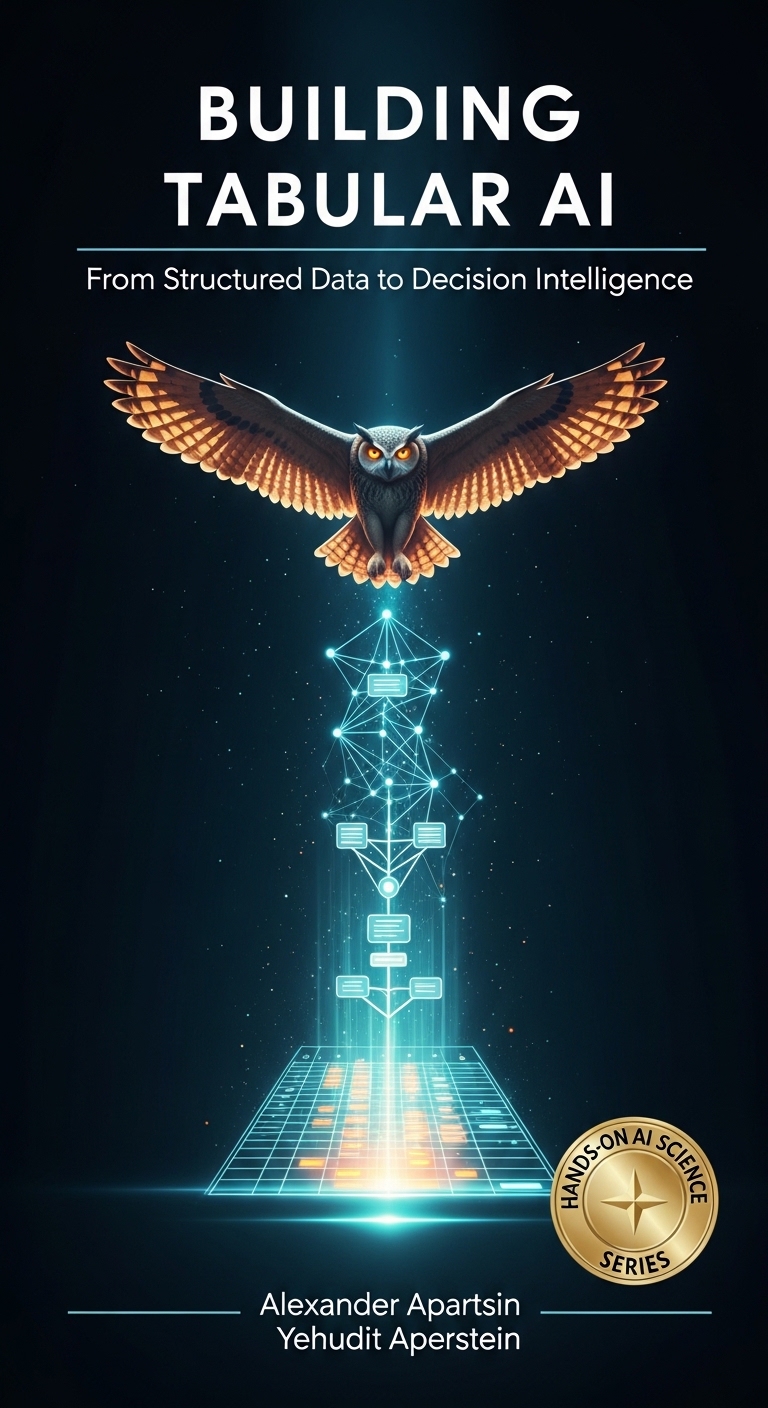
Building Tabular AI From Structured Data to Decision Intelligence
A practitioner's guide to tabular modeling, feature engineering, gradient boosting, deep tabular learning, causal inference, and decision intelligence.
Structured data is the substrate most deployed AI actually runs on: transactions, claims, customers, patients, loans, and the decisions made from them. This book is one connected journey through the theory, models, and engineering of tabular AI. It starts with the foundations of tables, targets, and leakage-safe validation, builds through linear models, gradient boosting, and deep tabular learning, then moves into imbalance and risk, explainability, causal inference, and decision optimization, before closing with the privacy, monitoring, and deployment concerns that govern real systems.
The Ten-Part Arc
Each part stands on the one before it; together they span the full craft of turning structured records into reliable decisions.
Foundations of Structured Data Intelligence
Tables, schemas, and keys; data quality and missingness; target and label engineering; and the leakage-safe validation every honest result depends on.
5 chapters · 5 labsStatistical & Machine Learning Foundations
The statistical spine: exploratory analysis, linear and generalized linear models, trees and ensembles, and the gradient boosting that remains tabular AI's baseline to beat.
5 chapters · 5 labsFeature Engineering & Representation
The central craft: numeric and categorical encodings, time and event aggregation, point-in-time correctness, external and embedding features, and reusable feature stores.
5 chapters · 5 labsAdvanced Tabular Modeling
The frontier beyond boosting: neural tabular networks, relational and graph-enhanced learning, AutoML and hyperparameter search, and the emerging idea of tabular foundation models.
5 chapters · 5 labsImbalance, Rare Events, Risk & Anomaly
The problems that dominate deployment: class imbalance, fraud and abuse, credit and risk scoring, anomaly detection, and survival and time-to-event modeling.
5 chapters · 5 labsExplainability, Debugging & Trust
Making models understandable enough for high-stakes use: PDP, ICE, and SHAP; counterfactuals and recourse; error analysis; fairness; and governance.
5 chapters · 5 labsCausal Inference & Decision Intelligence
Beyond prediction into decisions: causal graphs, A/B testing, observational causal inference, uplift modeling, and optimizing actions under real constraints.
5 chapters · 5 labsSynthetic Data, Privacy & Data-Centric AI
Improving the data itself: data-centric methods, synthetic tabular generation, privacy-preserving learning, and LLM-assisted tabular workflows.
4 chapters · 4 labsDeployment & Operations
Turning models into reliable systems: production scoring architecture, drift monitoring, continuous training and MLOps, human-in-the-loop review, cost and reliability.
5 chapters · 5 labsApplications & Future Directions
The field synthesized across finance, healthcare, retail, and operations, the research frontier, and an end-to-end decision-intelligence capstone.
6 chapters · 6 labsHow This Book Teaches
Five habits, kept in every chapter from the first join to the final deployed decision.
Leakage-Safe by Default
Time-aware and entity-aware splits, point-in-time features, and explicit leakage detectors run through every chapter, because an optimistic split is the most common way tabular results lie.
Strong Baselines First
Regularized linear models and gradient boosting come before deep and graph models, so you always know what a new method actually has to beat.
A Callout System
Pitfalls, math asides, real industry examples, and cross-references are typeset as distinct boxes, so you can read deep or skim fast and never miss a trap.
Exercises & Labs
Each chapter closes with a hands-on lab on real datasets (credit, fraud, churn, clinical), from quick checks to portfolio-ready projects.
Prediction Becomes Decision
Every model connects to a cost matrix, threshold, or policy; the book measures utility and decision quality, not accuracy in the abstract.
The Hands-On AI Science Series
Building Tabular AI is one of the connected books in the series, each a deep, build-it-yourself guide to a major field of AI.
Hands-On AI Science is a series of in-depth guides to the major fields of artificial intelligence. Every book goes deep into the theory, models, and internals, covering the classical foundations and the most recent ideas, then shows you how to build each one in Python with the modern libraries and tools that get the job done. The writing stays plain and light (illustrations, analogies, mental models, worked examples, and a little fun) without trading away rigor or coverage. Each volume is self-contained and complete enough to anchor a full course on its subject.
Building Tabular AI
From Structured Data to Decision Intelligence.
You are here